All Courses
Mastering Uncertainty - Think like a Nobel Prize winner
Advanced | Duration: 01:58 | Homework 00:45


Description
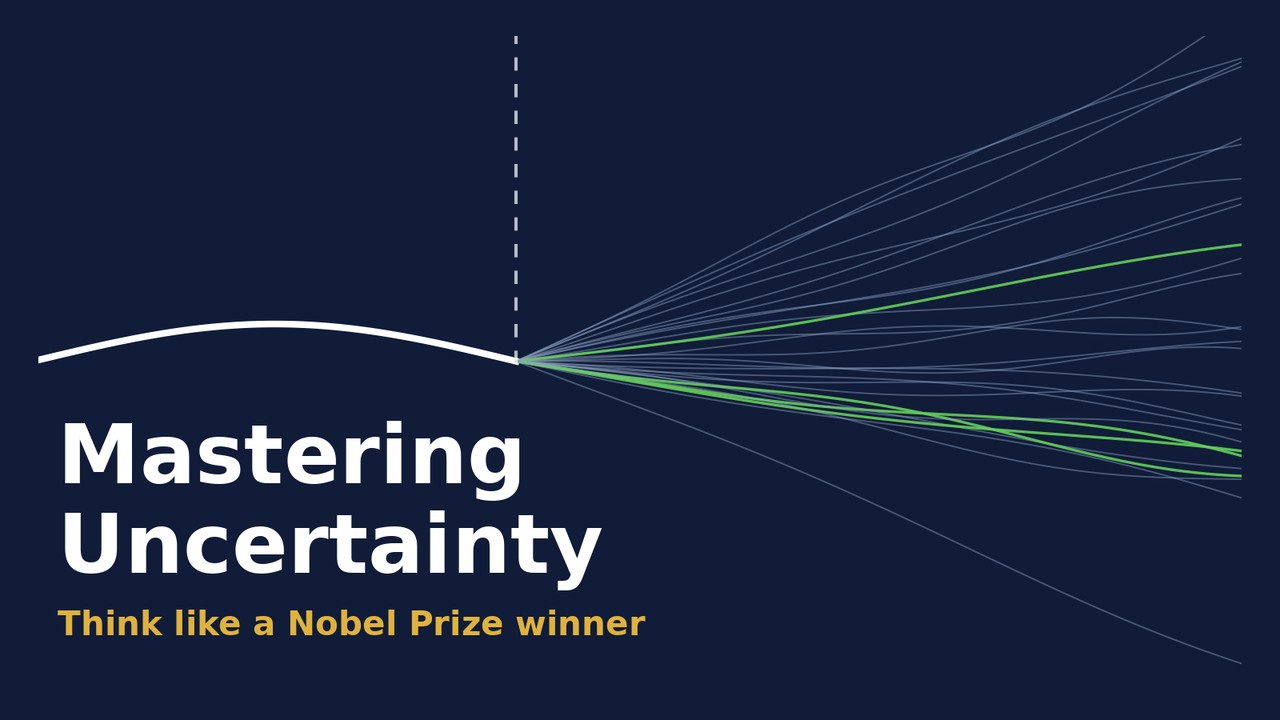
Some decisions cannot wait for certainty — and certainty never comes. This course teaches you to decide well anyway.
The method is not ours alone. Ten Nobel Prizes run through this course — from Kahneman's ambiguity aversion to the randomized trials of Banerjee, Duflo, and Kremer, the natural experiments of Card, Angrist, and Imbens, and the complex-systems physics of Manabe, Hasselmann, and Parisi. Mastering Uncertainty distills how the sharpest minds of the last century decided under the unknown — and turns it into a working method for your portfolio, your roadmap, and your next bold bet.
Built on Magnus Penker's masterclass Dancing with Uncertainty and the Innovation360 Uncertainty Model (Penker 2023), this 2.5-hour micro-credential (45 minutes hands-on, on your own portfolio) gives uncertainty the full treatment: philosophy, mathematics, and method.
You will learn to:
- Relate — see why uncertainty, like infinity, cannot be divided away (Knight, Hume, Cantor, Gödel) — and why that is the best business news of the year for anyone disciplined enough to exploit it. Three thousand years of thought about the unknowable, from Exodus to Kierkegaard's leap: method, not doctrine.
- Calculate — master the binomial toolkit: pre-set thresholds, the 2σ rule, guess-and-halve — and make ten users decisive. Then learn where every model breaks: chaos, fractals, the flaw of averages (Challenger), fuzzy logic, the Jevons paradox, the Drake mistake — and how to calibrate expert judgment when there is no data at all (Cooke; the IPCC scale). Name the world, then pick the instrument.
- Navigate — map your portfolio on impact × uncertainty, replace dates with thresholds ("we proceed if…"), hunt the killer assumption first, stage every commitment like an option — and lead so that uncertain work is small, cheap, reversible, and celebrated.
Included: The Uncertainty Toolkit (5 templates) · The Uncertainty Workbook (3 exercises + reflection) · the 16-page Course Companion with full references · certificate add-on, built to be worn on LinkedIn.
You cannot know. You can still decide well. What's your threshold?
Prerequisites and audience
No formal prerequisites are required, but a good understanding of ideation and a basic understanding of math, philosophy, and systems thinking is recommended. The course is designed for executives, strategists, innovation leaders, portfolio owners, and consultants. Innovation Sandboxing is the recommended companion course — taken before or after; the two are designed as a pair (the map and the moves).
Course Goal
After completing the course, participants can decide and lead confidently under irreducible uncertainty — and defend every commitment with a pre-set evidence threshold. They will be able to:
- Explain why uncertainty cannot be divided away — and why more analysis can never substitute for testing
- Apply the discipline of the unknowable: name what a claim is NOT (falsification as via negativa), hold what cannot be named, and act with a capped stake and a pre-set threshold
- Carve falsifiable questions out of open-ended uncertainty and make small samples decisive with the binomial and the 2σ rule
- Name the world before choosing a tool — designed trial, chaotic, scale-free, fat-tailed, vague, efficiency/Jevons, no-data, or Knightian — and select the matching instrument
- Detect the standard statistical failures in their own reporting: the flaw of averages, Simpson's paradox, point-estimate multiplication, and false crispness — and calibrate expert judgment with seed questions
- Map a portfolio on the Innovation360 Uncertainty Model and shape asymmetric bets — capped downside, open upside
- Replace date-driven plans with threshold-gated roadmaps: backcast killer assumptions and sort moves into robust / bet / option
- Install the leader's checklist: uncertainty budgets, celebrated kills, and map-and-log governance
- Route every roadmap gap to the right experiment level — and hand over to Innovation Sandboxing / Business Experiments (the HOW) and Transformation360 (the scale-up)
Certificate
Certificate: Mastering Uncertainty — available as a USD 29 add-on after passing all nine quizzes. A micro-credential for your LinkedIn profile.
Instructor
Magnus Penker
Magnus Penker is a Wall Street Journal and USA Today bestselling author and an internationally-renowned thought leader on innovation, sustainability, and business transformation. He is a speaker at prestigious global forums and events such as the Global Peter Drucker Forum, and at top-ranked international business and design schools, a variety of associations, and some of the world’s largest companies. Magnus recently launched the bestseller Play Bold, is writing a five-volume series The Complete Guide to Business Innovation, is a former contributing editor at the International Journal of Innovation Science, and pens a column for the American business magazine Inc Magazine.
As a result of these achievements he has been honored with the Business Worldwide Magazine’s award for “Most Innovative CEO Sweden 2016” and was appointed a Global Top 100 CEO by CEO Monthly in 2018. Additionally, he has launched 10 start-ups as well as acquired, turned around, and sold 30+ SMEs all over Europe.
Reviews
Jean-Bernard Martin
2026-09-11
Course structure, depth, and density of insights are outstanding. It is a powerful eye-opener and a concrete framework to rationally navigate the unknown, make uncertain decisions, and handle complex ambiguity.
Maria Marti-Fluxa
2026-08-31
This is super insightful course, applicable to so many spheres of life! The concept, tools and framework are articulated to provide a clear understanding of the approach.
Debasis Sengupta
2026-08-11
The course provided a practical and thought-provoking framework for understanding and managing uncertainty, one that goes beyond traditional forecasting and risk management. I particularly valued the use of real-world examples, experiments, and decision-making tools that I can apply in leadership, innovation, and organisational contexts. Thank you for giving me this opportunity.